Sunday, September 8, 2013

A Favorite: Dekalog

Kieslowski's 1988 masterpiece "The Dekalog" is a Polish TV miniseries that many film buffs simply consider to be one big fat ten hour movie. It's this film buff's 54th favorite movie of all-time, 2nd favorite Kieslowski film, 4th favorite film from the 80s, and favorite film of 1988. It tells ten different stories about different folks who all reside in the same apartment complex. In addition they're all watched by the same mysterious angelic figure. We might think of this figure, it has been suggested, as one of the angels in Wim Wenders's masterpiece "Wings of Desire." The stories more or less match up to one of the ten commandments, but each episode contains much more than a simple morality tale. Every Kieslowski fan must watch this. I suspect it's also a good entry point for new comers. Below are links to reviews for the individual episodes.


Friday, September 6, 2013

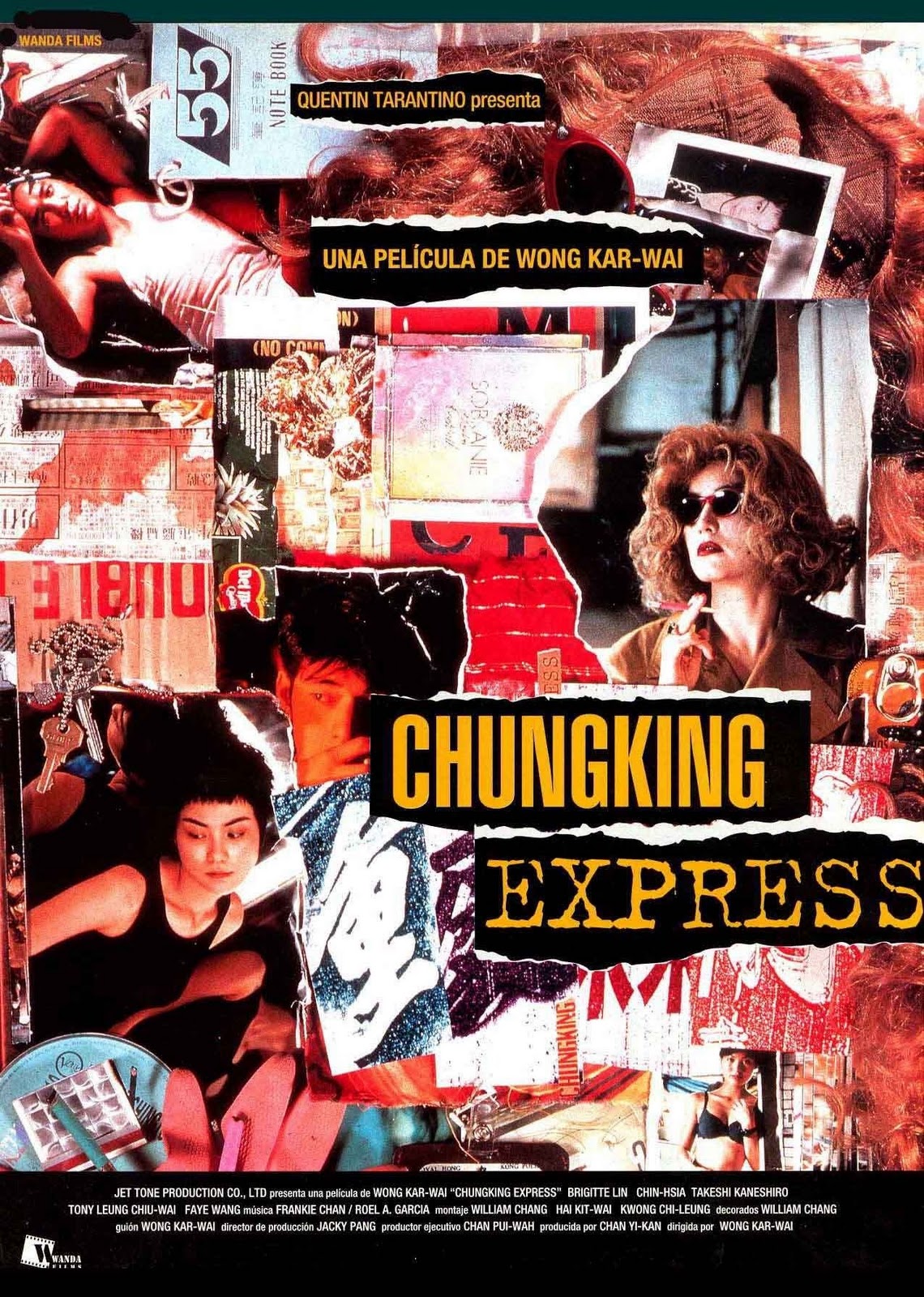
A Favorite: Chungking Express & Fallen Angels


Wong Kar-Wai's light, funny, romantic, and whimsical double bill "Chungking Express" and "Fallen Angels" are two of the best movies I have ever seen. They're tied for 80th place on my all-time list, tied for 2nd place out of my favorite Wong Kar-Wai films, tied for 5th place on my best films from the 90s list, and each first place for the years 1994 and 1995, respectively. The two films are two films, but they were initially conceived as one larger film. Hence, I like to treat them as one film, and I often watch them back-to-back in a single night (or try to). Structurally and stylistically they are very similar. Each tells two stories of love, and each has a very loose, experimental, and fast-paced style that is similar but different to Wong Kar-Wai's other films like "In the Mood for Love," "Days of Being Wild," "2046," and "Happy Together." Those films are equally experimental in style (they all have Wong's signature choppy slow-motion, for example), but they are slower paced and the camera movement is more mechanical than fluid. In "Chungking Express" and "Fallen Angels" Christopher Doyle, one of the greatest cinematographers of all-time, seems to wander the streets of Hong Kong, dancing and twirling through the crowds upon crowds of people until he settles on the core characters.

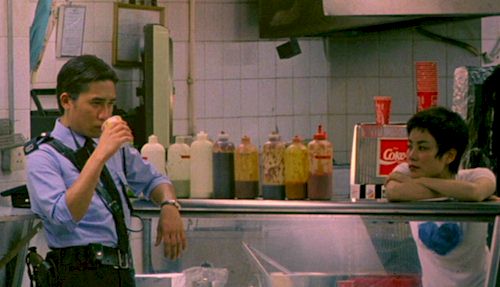
The characters in "Chungking" are, for the most part, people that work respectable jobs during the day. Both stories in "Chungking" center on two lovesick policemen. The first is played by Takeshi Kaneshiro (who also plays a character in "Angels;" more on that below). Kaneshiro's cop is trying to get over his ex, May, and finds himself falling for a paranoid (she wears glasses and a rain coat, you know, because just in case...) drug-smuggler (Brigitte Lin) instead. The other cop is played by the fantastic Tony Leung. Leung's cop is also trying to get over a relationship with a flight attendant (Valerie Chow) that he seduced ("There's always one you want to seduce"), but finds himself happily distracted by a quirky Midnight Express worker (Faye Wong) instead. The two stories really only intersect when one transitions to the other, but occasionally the diligent viewer can find instances when the second set of characters inhabits the world of the first set (see the picture with Faye Wong and Brigitte Lin, for an instance). The film is interesting in this sense. All characters are intensely lonely individuals even though they are surrounded by a sea of others, constantly crossing paths with all of them. The eye-poppingly lit and lensed cityscape is all that they share with each other.

I must say that I strongly disagree with two well-known critics on the film. Ebert said that "Chungking" was a cerebral experience rather than a film about life. Oh how I disagree. Wong Kar-Wai is one of the most visceral film-makers in my opinion. I am literally physically affected by his images and the aspects of real-life he captures. He's not at all like, say, Godard. The film is emotionally and aesthetically superb, and viewers should feel free to leave their thinking caps at the door. It's an emotionally captivating story of missed chances and love. Though James Berardinelli gave the film a positive review, he called it confusing and claimed it demanded subsequent viewings. I disagree here as well, though I support many, many viewings. Berardinelli has always struck me as the kind of critic that favors very cookie-cutter mainstream kinds of films. For those who are open to something new and ready to absorb, "Chungking" will not be confusing. Wong Kar-Wai provides enough of a plot for those who need it and enough style for those who want it. It is one of those films, I think, that mainstream audiences and film buffs can agree on insofar as they're willing to pay attention.

The characters in "Angels" work at night. Their jobs are not respected by societal norms. The first main character is a hit man played by Leon Lai. He's in love with his exotic "partner" (Michelle Reis) in crime though the two rarely directly interact. When he quits his job he arranges a meeting with her. However, he skips the meeting and instead meets Blondie (Karen Mok), a crazy prostitute, at McDonald's. The other main character is a mute who takes over peoples' businesses after-hours (toward the end of this story he can even be seen taking over the Midnight Express). He's played by Takeshi Kaneshiro. He and his father live in the same apartment building as Michelle Reis's character. He keeps running into a woman named Charlie (Charlie Young) during his "night shifts." Every night he sees her she tells him the same sob story and cries on his shoulder. Her ex-boyfriend Johnny left her for Blondie. Again, the film's central theme is being surrounded by missed opportunities to meet people and yet being alienated and isolated from such people.  

 "Angels" is perhaps even more cinematographically (and otherwise) experimental than its counterpart. It's constantly bathed in neon lights (not unlike Nicolas Winding Refn films), and the intro to the hit man is particularly memorable as it is scored to bits and pieces of a song that repeats "'Cause I'm Cool." And he is. It's hard not to think so what with all of the interesting low camera angles, wide-angle lenses, and slo-mo that Wong Kar-Wai and Christopher Doyle use to create their impressionistic painting of the seedy underbelly of Hong Kong. Despite the fact that all of the characters are lonely and sad, Wong Kar-Wai's penchant for off-the-wall coincidences and funny little vignettes within vignettes keeps the film at a bittersweet rather than full-blown depressing level. Though his review was overall positive, Roger Ebert seemed to think that the film was not for the average film-goer. And I again, strongly doubt this. I think the reason most people haven't seen it is largely because we in the states are underexposed to foreign films or films that try something new. And again, I must say this is the kind of art house film that respects mainstream and highbrow sensibilities equally. All in all, "Chungking Express" and "Fallen Angels" are, together, one big romance-inducing film that is at once gorgeous and hip, yet never too cute.

At the time of this review, "Fallen Angels" is on Netflix Instant!

Theatrical Release: Grandmaster (U.S. Cut)

Wong Kar-Wai's "Grandmaster" is now playing in theaters. I found this to be such a great film that it's now my second favorite film of the year. Most of the negative criticism seems to suggest that the narrative is messy and unfocused. I didn't think this was true at all. In fact, the film was very clear and understandable as long as you were willing to pay attention. One reviewer, for example, was confused about the significance of a button from a coat. The significance was so blatantly obvious that it seems to me that this reviewer did not watch the movie. It strikes me that many such reviewers were hoping for something more mainstream along the lines of the other recent films about Ip Man, namely, "Ip Man" and "Ip Man 2." Those films aren't bad, but "Grandmaster" is not a mainstream martial arts film. For martial arts and action fans, "Grandmaster" may be too finely paced, lack enough explosions, and fetishize the wrong things during fight scenes (raindrops and snow over fight moves). Other times, it seems even Wong Kar-Wai fans don't appreciate it because it's not "Ip Man: In the Mood for Love." However, for those looking for a Wong Kar-Wai film that isn't a repeat of what he's done before, "Grandmaster" is the treat we've been waiting for since 2004. As fans know, Wong Kar-Wai has never been a narrative story-teller. For him, mood and atmosphere reign. Though there are some minor flaws in it and is by no means his best, the film is better than most films that have come out this year.

The film tells the story of Ip Man (played by the excessively charismatic Tony Leung), the eventual teacher of martial artist and film star, Bruce Lee. The opening fight sequence is perhaps the most beautiful fight scene I've ever seen (even more beautiful and breath-taking than the scenes in "Crouching Tiger, Hidden Dragon"). Ip Man takes on numerous fighters, including Iron Shoes, in the streets of Foshan as it pours down rain on his signature hat. Then the story begins. A grandmaster from the cold north travels to the south to announce his retirement and a fight that will compare northern and southern fighting styles. The masters of the south are emphatically unanimous in their selection of Ip Man as their representative fighter. They spar with him in different styles. He also competes against the grandmaster himself in a battle of wits. When he "defeats" the grandmaster, the grandmaster's daughter, Gong Er (played by the beautifully deadly Zhang Ziyi), asks Ip Man if he will allow her to attempt to restore her family's honor. He agrees. A beautiful fight between the two in a brothel ensues. During the fight, the two almost kiss; it's a really fantastic shot. Wong Kar-Wai's camera gets in close and shows angles of fights that I've never seen in all my years as a martial arts film fan. She restores her father's honor by beating Ip Man because Ip Man makes the mistake of trying to help her from falling down a staircase. She and her family travel back north. Ip Man and Gong Er begin a long-distance romance of sorts. Ip Man plans to travel north to see her by buying a heavy coat. His plans are interrupted by the war with the Japanese. The two go about their separate lives, but never forget each other.

Later in the film there's a story-arc with Gong Er as the central character. It depicts what happened in her life during the war. If the first fight sequence in the film is the most beautiful fight scene I've ever seen, the fight scene at the train station in Gong Er's story-arc is a very, very close second. Gong Er's story, told in flashback, might be the best part of the film. In fact, Zhang Ziyi upstages Tony Leung with the little story-arc she is given. It seems Wong Kar-Wai's sensibilities are attracted to Gong Er's story more so than Ip Man's story. If I have any criticism, it's that the film is not long enough to explore Ip Man's life in a way that provides for emotional resonance with the character. However, it manages to do so with about 30mins of Gong Er's story. I suppose, I would have liked to see more or nothing at all of the fight scene between Ip Man and Razor as well. But that's really a small criticism. Overall, the film is worth watching on the big screen, if only for the cutting-edge, glorious cinematography that Wong Kar-Wai has always been known for. Each scene is exquisitely crafted and goose-bump inducing. Check it out in theaters soon, and I'll keep my eye out for when the Hong Kong cut will be available stateside. Perhaps it was even better before Harvey (Scissorhands) Weinstein got his hands on it. As a final note I should say that the fight choreographer here is the same fight choreographer for "Crouching Tiger, Hidden Dragon" and "The Matrix." So, if everything I said above wasn't enough to entice you, that should do it!

Monday, September 2, 2013

Netflix Streaming: Samsara

Ron Fricke's 2011 follow-up to "Baraka," "Samsara," is a stunningly beautiful achievement in non-dialogue experimental film-making. Who will enjoy this film? If you enjoyed "Man with a Movie Camera," "Baraka," "Koyannisqatsi," or "Sans Soleil" you'll enjoy watching the breathtaking imagery that is "Samsara." Terrence Malick fans will also likely enjoy this film (If I was Malick I'd be trying to get Fricke to do my cinematography; apologies to Lubezki). But even if you don't know who Malick is and you've never seen a non-dialogue experimental film in your life, "Samsara" is surely an excellent entry point.

The film was shot over a period of 4 years on 70mm. Fricke tracks massively beautiful scenes from across the globe as well as its tiny-in-comparison inhabitants. He uses slow-motion, time-lapsed photography, and original camera movement that induces a visceral experience (visceral experiences are my favorite kind when it comes to film) in the viewer. The entire film and score moves with the rhythm of the ocean's tides. It's simply captivating. The word "Samsara" has to do with the wheel of life in Tibetan Buddhism. Within the first 30mins of the film, we see Tibetan monks painstakingly creating a sand painting of the wheel of life. In the end we see them destroy it. It's a practice to teach the impermanence of all things. Indeed, the entire film can be seen as telling a story via "intellectual montage" of life & death, permanence & impermanence, and the flow of life.

Some of my favorite parts include a tattooed man with a child, a thrilling sequence of a man creating creepy masks out of clay on his face and then destroying them, a dance sequence performed by prisoners, a sequence of worshipers at Mecca, time-lapsed sequences of the moon and sun moving across the sky, the time-lapsed sequences hovering over neon-lit cityscapes, and all of the close-ups of people starring intimately into the camera (an underused emotional device in narrative cinema). I highly recommend checking out this wonderful instance of pure cinema on Netflix Instant. I'm sure you'll be blown away by the imagery. It's definitely one of my favorite films of 2011.

Friday, August 30, 2013

Netflix Leaving: Hotel Rwanda and Leaving Las Vegas

2004's "Hotel Rwanda," starring Don Cheadle, is unfortunately expiring on Netflix Instant by the end of the month. The film is a harrowing experience. Called the "African 'Schindler's List'" on more than one occasion, the film is about the real-life Rwandan genocide that took place as recently as spring '94. An estimated 800,000 (mainly Tutsi) were killed by Hutu extremists. Both "Schindler's List" and "Hotel Rwanda" tell the uplifting and hopeful side of disturbing real-life events and focus on one man who risks his own neck to save the lives of many. Don Cheadle plays the hotelier Paul Rusesabina, who tries to rescue his fellow citizens by allowing them to take refuge in his hotel. His performance is powerful yet subtle. Nicke Nolte is also (as usual) equally great in it. He plays a colonel of the UN Peacekeepers. His character is not allowed to intervene on the genocide. I watched this in 2004/2005 in Portland, Oregon with some friends from college. Roger Ebert put my experience into words perfectly: "The film works not because the screen is filled with meaningless special effects, formless action and vast digital armies, but because Cheadle, Nolte and the filmmakers are interested in how two men choose to function in an impossible situation. Because we sympathize with these men, we are moved by the film." One of the greatest things about the film that I can remember is that the film does not show brutal violence. It mostly focuses on its aftermath. It's use of music leaves much to be desired in that it's very conventional. There are some scenes that are contrived, but overall the film is worth watching. Check it out on Netflix Instant before it's too late. It is an overwhelming experience that boldly forces you to reflect on global responsibilities.

Mike Figgis's 1995 bittersweet, tragic romance "Leaving Las Vegas," featuring one of the best (if not the best) performances by Nicolas Cage, is, alas, also leaving Netflix Instant. The film tells the autobiographical story of John O'Brien. Nicolas Cage plays a Hollywood screenwriter who dumps everything and now plans to drink himself to death in Las Vegas (O'Brien killed himself shortly after filming began). In Las Vegas he meets a prostitute (Elisabeth Shue) with an abusive pimp. The film focuses on these two sad, self-destructive individuals in their relationship, which surprisingly seems very loving. Figgis used 16mm to shoot with, composed his own (fantastically moody jazz) score, and was forced to avoid cops on The Strip as filming permits were not allowed. It is a shoestring Indie that accomplishes what it sets out to do with fervor. The film succeeds because it sticks to the principle of observing the behavior of these two individuals from a sort of objective distance. We don't "see" into their minds, and the film is not trying to pretend they can be saved. There's never a moment in the film where it gives the viewer false hope that Cage's character won't kill himself and that Shue's character will save him with her love. It's my favorite kind of narrative-based film-making. Think "The Wire" rather than "The Sopranos." The score compliments the film exceptionally well. On the whole, the film is both charming and disturbing. Sometimes I think of it as a Lynch film that takes place in the real world rather than the Lynchian universe. The film is an exception to the rule that critics like sad endings and audiences only like happy endings. It did quite well both critically and at the box-office. You'll surely fall in love with this film. Be sure to check it out before it's too late.

Friday, August 23, 2013

Netflix Instant: Pulp Fiction and The Future

Quentin Tarantino's 1994 "Pulp Fiction," one of the most influential movies ever made, is now on Netflix Instant. As with many Tarantino flicks, "Pulp Fiction" unfolds non-linearly (but it's not as jumbled as one might expect having become accustomed to this device with more recent films, e.g., "Memento"). Pumpkin (Tim Roth) and Honey Bunny (Amanda Plummer) eat a late breakfast at a diner. They decide to rob it. The credits roll. Much earlier that day, Samuel L. Jackson and John Travolta, who play two L.A. mobsters, are on their way to make a hit for their boss Marsellus Wallace (Ving Rhames). They discuss many things in fast and witty Tarantino dialogue. Chiefly, they discuss a rumor that Marsellus Wallace threw a dude out of a window for giving his wife---Mia (Uma Thurman)---a mere foot massage. When they get to the site, Samuel L. Jackson's character makes the hit after reciting Ezekiel 25:17. Later in the afternoon in a empty cocktail bar, boxer Butch (Bruce Willis) accepts money from Marsellus to throw a fight. And so begins a story with a lurid subject matter. When I first watched this film, I was blown away as it was as novel to me then as it was to the film world in 1994. I still really like it---it's my 5th favorite Tarantino piece---but I admit it's lost some of its luster for me over the years. Some sequences---especially the one involving bondage and rape---now seem to me to be acts of desperation on the part of an immature filmmaker. And though I can generally laugh about Tarantino's acting (I actually liked him in last year's "Django Unchained"), "Pulp Fiction" must feature the worst acting from Tarantino. Many critics place this as the number one film of the year and/or decade, whereas I would say films like Wong Kar-Wai's "Chungking Express," Kieslowski's "Red" and "White," or Bela Tarr's "Satantango" (depending on my mood) easily take the cake for 1994. Even films like Terry Zwigoff's "Crumb" and Tim Burton's "Ed Wood" continue to radiate upon reviewing better than "Pulp Fiction." Still, "Pulp Fiction" is a wonderful film that cannot be missed by any one up for adventurous film-making. The film is especially fun for film-lovers because of its references to other films such as "Band of Outsiders," "Deliverance," and "Deer Hunter" to name only a few. I had the pleasure to finally see it in theaters during the "20 years of Tarantino" celebration last year. The glorious long takes and pop-literate conversations were all the more engaging. It made me think that "Pulp Fiction" should only be seen on the big screen. But, alas, that's difficult or near impossible for most. Hey, at least there's Netflix!

Miranda July's 2011 "The Future," starring Miranda July and Hamish Linklater, is also streaming on Netflix this weekend. To use an overly used word to describe this kind of movie: "The Future" is a quirky little film. It has something like the feel of a Wes Anderson film with a touch of magical realism. The premise is quite silly but fun. Sophie (July) and Jason (Linklater) are two 35 year olds of a four year relationship in L.A. They're used to each other but seem to fit together like hand in glove. They decide to adopt Paw Paw (who occasionally narrates the story), an injured cat at a local shelter, in a month. They do a little bit of weird reasoning (“We’re 35 now ... by the time the cat dies, we’ll be 40 ... and 40 might as well be 50 ... and after that, spare change.” “Spare change?” “Less than a dollar---not enough to get anything you want …”) and come to the conclusion that this is the last month of real living that they have in their future. So they decide to drop everything and do whatever the universe tells them to do instead (they're better at this than Tobias from "Arrested Development" in that they actually seem to pay attention to the signs). All of the characters are, shall we say, a little off, but it's a treat to let July take us on her ride. She creates her own world, and, in that world, examines love, time, and death. In this regard it's not unlike Terrence Malick's "Tree of Life," which also came out that year. Though "The Future" is not as successful as "Tree of Life" in its meditation on such heavy themes. Some plot parallels and themes are not emphasized enough, I think, and, moreover, there isn't a core to hang on to like childhood in Malick's film. It's difficult to become emotionally engaged with the couple as they are mostly seen doing things independently of each other. There's enough there to infer the stakes and the love in their relationship. I just don't think it's enough for the kind of emotional impact needed to make "The Future" a lasting experience like "Tree of Life." The ending is perfect though. July's subtlety is much appreciated. It leaves open both how we should feel about the couple's future and their relationship and the interpretation of how Sophie and Jason feel about their future and relationship. I've seen both of Miranda July's films (the other being "Me and You and Everyone We Know," which I will review someday), and I must say that I look forward to her next film. She's a fresh new female voice that is much needed on the contemporary movie-scape. Give this film a whirl on Netflix Instant!

Friday, August 16, 2013

A Favorite: Seven Samurai

Akira Kurosawa's 1954 masterpiece "Seven Samurai" is my 21st favorite movie of all-time, my 2nd favorite film of the director, and my 9th favorite film of the 50s. Typically I review "Netflix Instant" movies and occasionally "Theatrical Releases." Well, this is neither. This is the first movie I'm going to review that's just a plain old review of one of my favorites. I recommend you get your hands on it in anyway possible. Even if you've already seen it, this film is worth sitting down for a very quick 3.5hrs again and again. If you haven't seen it, there are some spoilers ahead. The story is divided into four parts: the setup, complications and resolution, development, and, finally, the climax. First we see a small village of farmers who discover bandits will descend on them soon after the harvest. Some of the villagers go to the patriarch of the village, Granddad. His idea is to go into a nearby town and bring back hungry samurai-for-hire to help protect them.

A group of farmers goes to the town and finds that hiring samurai is much, much harder than expected. The samurai they first come across are either just plain mean or weaklings. However, soon they begin to find willing and very able samurai scattered among the town. We're introduced to each of them in every way from comical to bad ass. The first shaves his head to trick a thief into thinking he's a monk in order to bravely save a child from his clutches. The second is just a young samurai who looks up to the first. He seems like a rich kid (though not at all a spoiled brat) who ran away to look for a master. The third and fourth are some rather plump samurai who are nevertheless trustworthy allies as well as perfectly able (the test the first samurai gives one of them is quite funny). The fifth (my favorite) is seen reluctantly destroying a fool in a sword battle, and the sixth is more of a comedian than a samurai (they find him chopping firewood with great concentration and decide he's good enough). And, of course, the seventh is played by the great Toshiro Mifune. He's the outsider of the group. It's likely he's never been in a real fight, but has more gall than all of them.

In the development phase of the movie, the six samurai, well, and Toshiro Mifune's character, return to the village and prepare for the bandit's attack. During this part we learn more about all of the samurai and some key villagers. This is also the time where secondary aspects of the situation are fleshed out. Suspense is built as the final part is delayed. Once we know everything we need to know about the stakes and about how well-prepared the village is for bandit onslaught, the final part, the climax, begins. Now we just watch as their plans work.

Perhaps surprisingly, this was Akira Kurosawa's first samurai film. He had originally wanted to make a film about a day in the life of a samurai, but he later discovered a story about samurai defending a village. It was originally going to be "Six Samurai." Then during the writing of the script Kurosawa and the other writers decided "six sober samurai were a bore---they needed a character that was more off the wall." Enter Toshiro Mifune's character, the seventh samurai. Through improvisation, Toshiro Mifune, a master actor, does indeed create an off the wall character. Sometimes during the fight scenes it looks as if he learned to fight by watching monkeys.

Earlier I said that this was a "very quick 3.5hrs." The fight and battle sequences, scattered throughout, are visceral and the character development and character complexity is so interesting that those hours of your life will fly by. What's perhaps most interesting in the film is the continual questioning of what's/who's good and what's/who's bad. In one scene, Toshiro Mifune's character angrily argues that the samurai have been abusing and exploiting the peasants for centuries. Are they bad or good? Are the bandits bad or good? Are the villagers bad or good? Are particular individuals bad or good? The film plays around with notions of good and evil making the viewer question along with it. This makes for an exciting movie even without all the action. In the end it's obvious that the samurai were a lesser evil than the bandits, that is, at least for this time slice of the village. After they're job is finished, they are no longer needed nor wanted by the villagers.